Emergent Weeds: On What We Tend Before It Takes Root
False Spring Brings Early Lessons
It was one of those unseasonably gorgeous days of false spring — that fleeting late-winter gift that makes it nearly impossible to stay inside. Warm, bright, dry. The kind of day that practically begs to be used well, especially when more rain is waiting in the wings. I have two dozen fruit trees that need their late-winter pruning, and a few dry days in a row matter: fresh cuts and wet weather are an open invitation to trouble. I went out with purpose this week, armed with freshly-bleached pruning saw and Felcos, ready to make the most of it. I got a few trees done before the ground beneath the plum tree caught my eye and pulled me down into the soft soil, face to face with a familiar troublemaker.
Shotweed.
The Urgency of Small Things
If you garden long enough, you learn to pick your battles. Some weeds earn a shrug and a muttered, I’ll get to you later. Some even earn a kind of grudging respect — tenacious, persistent, determined little things, carving out space wherever they can find it. You can’t pull them all, and nature abhors a vacuum, so in many cases it’s best to simply let them take up the space for a while. I’ve written about it before. The garden would have you on your knees from dawn to dusk if you tried pulling every weed as soon as it appears.
But shotweed is different. Shotweed is one of those gasp, drop everything, jump on it now situations. Timing, in this case, is everything.
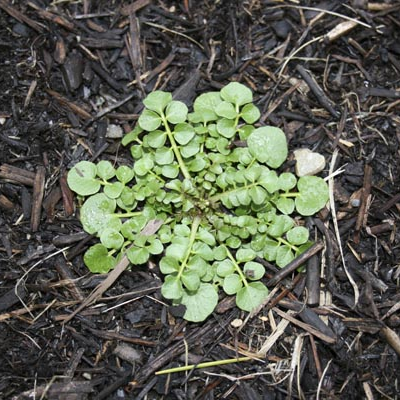
Shotweed, aka Hairy Bittercress, slips in quietly and moves fast. Those unassuming little rosettes of rounded leaves hugging the soil as they emerge can start flowering in just two weeks. Once the flowers appear, the seeds can mature just days later — and once they do, the plant essentially becomes a tiny botanical catapult.
If you’ve ever had the pleasure, you know: leave shotweed too long and it does not go quietly. Once it sets seed, it punishes you for your delay by flinging tiny, needly projectiles in all directions when disturbed — including directly into your face. It’s a remarkably spiteful little plant.
And so, the broad patch of it carpeting the ground beneath the plum tree instantly redirected my attention. Little starbursts of green, several already sporting their dainty white flowers. Harmless-looking, really. Almost sweet. Almost.
Apparently, I must have been too late last year, because this patch had claimed a generous swath of territory. But the ground is still soft from winter rains. The roots are shallow. They’re easily lifted by hand with the most satisfying series of yoinks.
Not today, Satan, I muttered, as I deftly pull-pull-pulled my way across the patch.
There is a deep, bodily pleasure in removing something that does not belong, especially when it comes easily. The earth opens without resistance. The roots slip free without disrupting the delicate microbiome below. No wrestling. No collateral damage. Just a clean release.
The Gift of Early Noticing
This, I’ve learned, is the gift of early noticing.
In the garden, timing matters. Pull weeds when the soil is soft and their roots are still tentative, and the work is simple — almost merciful. Wait too long and the job can change shape entirely. Allow them to flower, to set seed, and what could have been a ten-minute task becomes an ongoing negotiation, season after season.
With the soil still soft and roots still tender, the work passed quickly, almost indulgently — the pull and release imprinting a small rhythm into my hands and breath as I moved beneath the wide canopy of the plum tree. And of course, as I worked, my thoughts drifted.
Because it is nearly impossible to kneel in damp soil, hands deep in living earth, and not begin to think about what else might be asking for attention.
Life has many versions of its own emergent weeds.
Small discomforts. Slight misalignments. The way we laugh off a comment that actually stings. The moments we tell ourselves it’s easier not to say anything, not to make waves, not to complicate things. All the subtle ways we swallow our own needs in favor of yielding to the insecurities of others.
Left alone, they do what all living things do: they grow.
For a long time, I practiced a kind of emotional gardening that prioritized peace over health. I learned how to smooth, soften, accommodate. I learned how to fawn, how to please, how to make myself smaller so that others could remain comfortable. When something felt wrong or even unsafe, I tucked it away, telling myself it wasn’t worth naming.
But unspoken things do not disappear. They root.
They settle in. They spread. And slowly, imperceptibly, they begin to establish ground rules we never meant to write.
What we don’t name, we normalize.
What we tolerate, we teach.
There is a cost to that kind of silence. It quietly compounds.
What I am learning now — awkwardly, imperfectly, very much in progress — is the mercy of early removal. The kindness of noticing discomfort when it is still small. The respect of naming it before it hardens into resentment. The self-trust of believing that my needs deserve air and light.
Choosing What Takes Root
This does not come naturally to me. My first instinct is still to make myself smaller and prioritize other people’s comfort over my own. But these days, there is another voice alongside it — steadier, quieter, more grounded — reminding me that boundaries are not punishments; they’re maintenance.
Like weeding.
I don’t pull shotweed because I hate it. I pull it because I love what I am trying to grow.
Some situations ask more of us than we can honestly give. Some relationships reveal limits we wish were different. Some encounters sting, even when we do our best to meet them with grace. I am learning that I am not required to stretch myself past recognition in order to make space for others. Meeting people halfway, it turns out, is often more than enough.
And when the actions of others hurt us, the pain is unavoidable — but we can choose whether we let it take root.
Mercy in Yielding Soil
Sometimes the kindest thing I can do for myself is to notice early, tend gently, and let go without fanfare.
When I finished moving across that soft earth and stood, the patch beneath the plum tree breathed a sigh of relief. The soil lay open and dark, ready for what comes next. I brushed the dirt from my knees and tasted that particular Imbolc scent of late-winter — wet earth beneath old leaves, the faint promise of green hinting in the corners.
The garden teaches us the value of attentiveness, of quiet consistency in our efforts. It teaches us to show up when the ground is soft, to choose gentleness over delay. Over time, we learn to trust that small acts of tending, done early and often, shape entire seasons.
There will be more weeds. There always are.
But this week, at least, the soil was yielding and kind. And I was paying attention.
Love,
Karin (with an eye)